
- News
- City News
- chandigarh News
- Chamkila’s popular songs revealed Punjab’s dark, feudal underbelly
Trending
This story is from May 29, 2023
Chamkila’s popular songs revealed Punjab’s dark, feudal underbelly
Unprecedented popularity and his mysterious killing during Punjab’s period of militancy has led to renewed interest in singer-writer Amar Singh Chamkila, born Dunni Ram in July 1960 near Ludhiana. With at least two biopics in the making, the focus is back on his songs with double entendres and descriptions of illicit relationships, alcohol and drugs
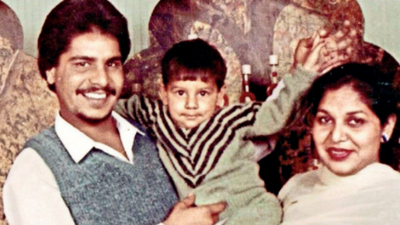
Amar Singh Chamkila and Amarjot Kaur in happier times

His remarks aptly describe, at least metaphorically, how Punjab’s rural hinterlands mourned the death of the wildly popular singer, who had almost become mainstream of Punjabi singing, even though the content he offered could never – neither before nor after him -become a part of the mainstream Punjabi singing.
Punjab’s cities and villages after the Green Revolutio n embraced a new wave of modernity due to the new wave of affluence. If its universities and colleges were registering record enrollment of village boys and girls, hordes of newly-employed youngsters were migrating from villages to cities.
The literary landscape of such urban centres was peppered with sophisticated literary traditions, whose mild-mannered doyens and doyennes were jewels of this new emerging upper middle/middle class. The likes of Amrita Pritam,Sahir Ludhianvi, Shiv Kumar Batalvi, Jaswant Kanwal, Avtar Paash, Balwant G argi and a whole generation of literati representing progressive literary tradition were their icons. However, Chamkila’s audience was somewhere else. He was a rage among the masses, especially among ru ral folks, who were not inclined to appreciate the complex aesthetics of higher artforms.
Be it in hostel rooms of colleges and universities, tubewell quarters of labourers in the farm fields, eve ning marriage parties or cabins of truck drivers, Chamkila made his presence felt everywhere. Given the vulgar content of his songs, Chamkila’s cassettes were prohibited in family homes and even in public places. Despite that, paradoxically, Chamkila was literally everywhere in the Punjab of the mid-1980s and thereafter.
In Punjab, nobody enquires about the scale of popularity of Chamkila, who, during the peak of his career, would deliver around 350 live performances in a year. However, the question that the masses and literati still discuss is the reason behind the phenomenal popularity of the slain singer, most of whose songs were loaded with expressions of sexuality, nudity and references to illicit relationships. “Leave alone the higher art forms, Chamkila didn’t even belong to the folk tradition of Punjabi singing. But yes, he was a representative of popular literature/singing .
He wrote and sang in accordance with the taste of ordinary people. No doubt that the themes he chose were full of sexuality and immoral relations. But the fact is that while liste ning to his songs, a rustic Punjabi would feel that Chamkila was singing about his own dreams, desires, fantasies and frustrations,” says Dr Surjeet Singh, professor and former head, depart ment of Punjabi, Punjabi University, Patiala.
Dr Nahar Singh, former professor, department of Punjabi, Panjab University, Chandigarh, who spent his academic career documenting Punjabi folklore, also opines that the reason behind Chamkila’s success was his ability to express those emotions in singing that people can’t discuss with others even now.
“His songs were loaded with themes, discussion aboutwhich is otherwise not possible. In his singing, Chamkila would articulate a person’s selfishness and desire. He created themes str uctured around sexual content. Themes that exist on the cultural periphery became part of his singing,” says Dr Nahar Singh.
It’s not that he gained popularity only because of the vulgar content of his songs. His creativity and ability can be gauged from the fact that even the religious songs he sang during peak of militancy becam e instant hits. Militancy ended by the 1990s. However, such songs, most of which were duets, are still popular.
His most popular religious song, “Baba Tera Nankana,” referred to the Par tition and how it rendered Sikhs unable to freely pay obeisance at Nankana Sahib, which had gone to Pakistan’s kitty. Its lyrics eulogise Hindu-MuslimSikh brotherhood in Punjab and how the Br itish had sown seeds of disharmony.
Chamkila was not the first singer in Punjab to sing vulgar songs. Punjabi singing folklore is loaded with vulgar and immoral content. Before Chamkila , there were lyricists who penned songs centered around sexuality. But no one dared to express it as openly as him.
“Even today, people sing such songs, but in closed groups. Even before Chamkila, lyricists wrote about themes of sexuality, but such expressions were woven in metaphors. Chamkila expressed such themes overtly. He neither shied f rom recording cassettes nor expressed reluctance to sing such songs on open stages and akharas,” adds Dr Surjeet.
In the early 1980s, Punjabi duet singing was still popular. But the popular ity of Punjabi folk singers like Kuldeep Manak and Mohammad Sadiq was at its peak. The then young heartthrob Gurdas Mann had already appeared on this landscape with his progressivemodern singing mannerisms and a new chapter in Punjabisolo singing had already started. He was soon joined by Hans Raj Hans and Sardool Sikander.
At this point, Chamkila en tered the scene with a bang. Moreover, the Khalistan movement was at its peak. Despite all such odds, Chamkila turned himself into a phenomenon by simply lifting the veil of Pun jab’s feudal society and presenting the audience with all that lay in its dark underbelly. He did this using his unique voice, pleasant tunes, creative lyrics and charming on-stag e performances.
By the mid-1990s, Punjab began to change drastically. The postliberalisation Punjab’s cultural landscape witnessed the emergence of several singers, whose songs c an be categorized as “populist. ” Prominent among them are Honey Singh and Sidhu Moose Wala. They also sang what sounded pleasant to the ears of the common Punjabi audience. However, none of them could surpass Chamkila’s fame. The reason is simple -no one had dared to be as overt, creative and gripping as Chamkila.
Hence, even 35 years after his death, one can still hear his songs in hostel rooms, tubewell quarters, marriage parties and cabins of truck drivers. True to his name, he is still Cham kila — scintillating!

About the Author
Amaninder Pal SharmaEnd of Article
FOLLOW US ON SOCIAL MEDIA










Photostories
Hot Picks
TOP TRENDING
Popular Categories
Hot on the Web
Top Trends
Israel Hezbollah WarIndia Qualifying ScenarioBaba Siddique NewsPakistan Cricket TeamRussell WilsonsSpacex StarshipRahul DravidBabar AzamNTA SWAYAM July RegistrationLawrence BishnoiAmazon LayoffsTaylor SwiftManagement Colleges of IndiaTop Medical Colleges of IndiaTop Engineering Colleges of IndiaTop Pharmacy Colleges of IndiaLive Cricket Score
Trending Topics
Diwali WishesNara RohithBaba SiddiqueShraddha KapoorVettaiyan CollectionVettaiyan ReviewNatasa StankovicDevara CollectionBigg Boss 18Deepika PadukoneShraddha KapoorRatan Tata Passed AwayJigra Movie ReviewVettaiyan Movie ReviewSwatantrya Veer SavarkarDussehra 2024Star Health Hacker DemandedViral MemesUltimate Football Codes October 2024Wordle Answer
Living and entertainment
Latest News
10 deadliest snakes in Australia and know their venom toxicityOver 70 injured at Devaragattu Banni stick festival during Dussehra celebrationsPassion missing, players don’t want to work hard, lament former intl’sHow tomato, potato, onion influence food inflationExclusive: Aishwarya Khare recalls his childhood memories of Dussehra, says 'my father used to take us all to watch Ram Leela and Ravan Dahan'Biker’s death ignites village fury in Odisha's Boudh, massive traffic jam on NH-57Reliance Jio sends 'complaint letter' to telecom minister Jyotiraditya ScindiaWomen's T20 World Cup: Why India need Pakistan victory over New Zealand to secure semifinal berthCops probing Bishnoi gang's links to Siddique's murderKrushna Abhishek shares a heartwarming post for mama Govinda; says 'jab body mein adha blood supremely talented actor Govinda ka ho...'Exclusive! With the work experience I have, I didn’t get the desired increment, says Neil BhattPapankusha Ekadashi 2024: Date, Parana Time, Puja Rituals and SignificanceNorth Korea preparing to demolish inter-Korean roads, claims South KoreaAI’S OppenheimerRajveer Singh’s inspiring transformation on completing a decade in the TV Industry, says 'My passion for becoming an actor fueled my determination'India's Best Dancer 4: Karisma Kapoor recalls celebrating her favourite festival with granddad Raj Kapoor, says 'I used to go to RK studios for my Dadaji's Holi parties'Ashton Kutcher and Mila Kunis consider leaving Hollywood amid Sean 'Diddy’ Combs' arrest fallout: ReportFormer Pakistan PM Imran Khan's sisters shifted to Jhelum jail on judicial remand
Copyright © 2024 Bennett, Coleman & Co. Ltd. All rights reserved. For reprint rights: Times Syndication Service